
Share the delivery
Send common content across shared multicast paths, then replicate it closer to viewers. Reduce redundant upstream traffic when audiences converge.
Blockcast · Multicast over the Internet
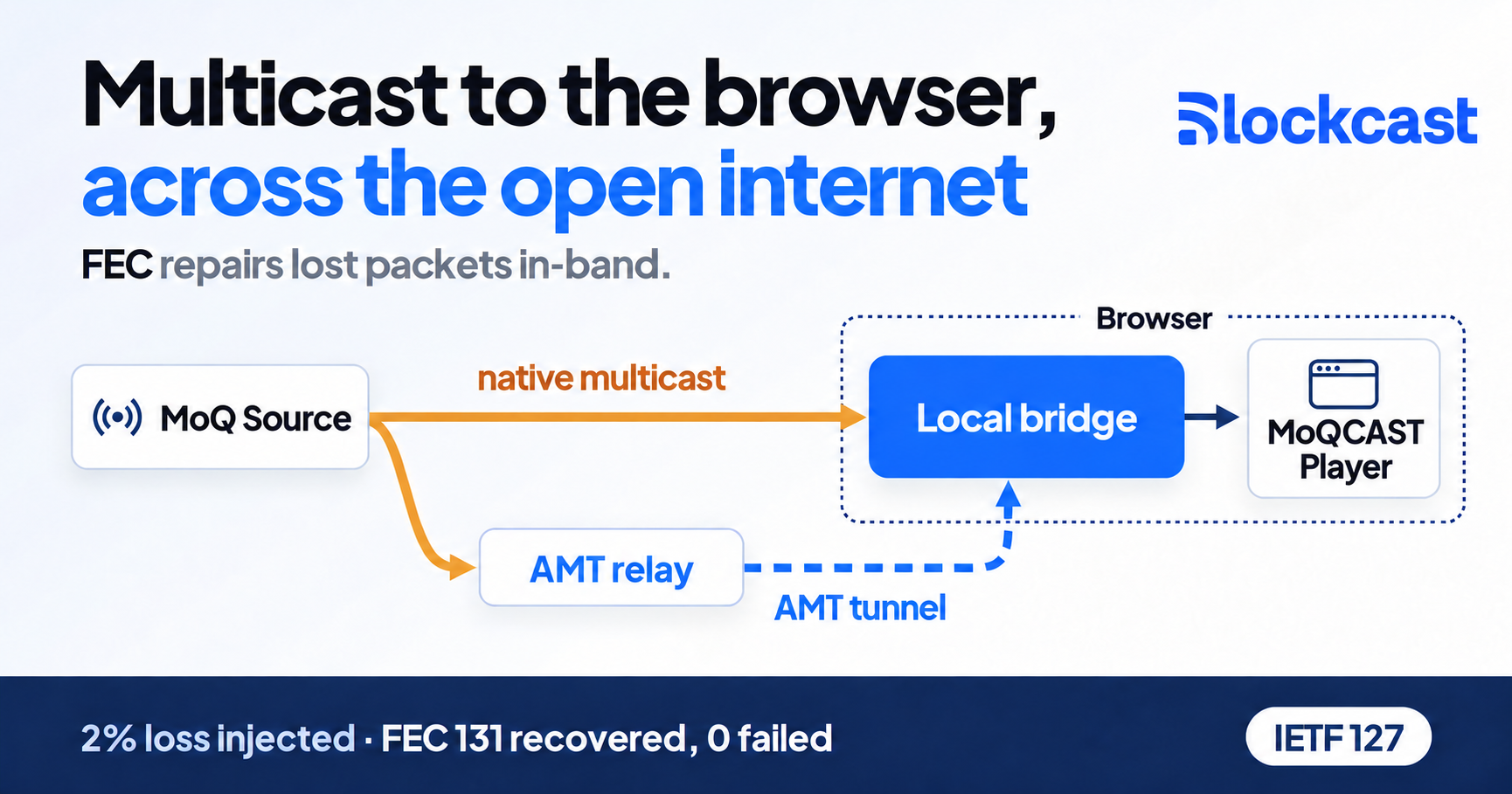
A bigger audience shouldn’t mean more copies of the same stream on every shared path. See how Blockcast solves that with multicast over the internet, while forward error correction repairs lost packets in-band so the player doesn’t wait a round trip for a retransmit.
The 45-second video below shows it in action.
When viewers watch the same live event over unicast, each receives a separate flow. Across shared network paths, those duplicate bits consume capacity again and again, adding delivery costs and pressure at the moments demand is highest.
Packet loss adds another challenge. With TCP-based delivery, missing packets are retransmitted, and later data can wait behind them. Recovery and buffering can push viewers further behind live or interrupt playback.
Forward error correction (FEC) takes a different approach: send repair data so a receiver can reconstruct missing packets. That can avoid a retransmission round trip, but repair overhead and the time needed to collect a block still matter. Reliable, low-latency delivery is a balancing act.
The bigger picture
Why peak demand exposes the limits of delivering the same content one viewer at a time.
Multicast sends shared content once along a common path and replicates it where routes diverge. More viewers can share delivery capacity, reducing duplicate traffic and the cost of serving simultaneous demand.
Historically, those benefits were largely confined to managed networks. Native multicast was never broadly available from end to end across the public internet. Automatic Multicast Tunneling (AMT, RFC 7450) bridges the gaps by carrying multicast across networks that support only unicast. Where homes lack native multicast, AMT-capable ISP routers replicate the stream at the edge and tunnel it to receivers. Operators can use existing compatible routers—no new hardware required.
Multicast addresses duplication; FEC addresses packet loss. Together with targeted repair, they let Blockcast reduce repeated delivery while helping receivers recover missing data. Actual latency depends on the network, recovery settings, and playback buffer.
Inside the innovation
How AMT, edge RELAY nodes, and browser playback bring shared delivery within reach.
03 / Multicast to the edge
Send common content across shared multicast paths, then replicate it closer to viewers. Reduce redundant upstream traffic when audiences converge.
AMT carries multicast through unicast-only stretches of the internet. Combine native multicast and tunneled delivery without waiting for every router to change.
FEC sends repair data in-band, letting receivers reconstruct lost packets without waiting a round trip for retransmission when enough repair data is available. Targeted unicast repair covers losses beyond that protection.
Edge RELAY nodes can turn multicast into ordinary HTTP delivery for existing players and download managers. Extend your CDN strategy with shared distribution.
Multicast Gateway (BEACON), Blockcast’s Chrome extension, lets web apps receive native and tunneled multicast through the local Blockcast bridge. Viewers stay in their browser.
Software RELAY nodes run on existing infrastructure in ISP networks, campuses, venues, and data centers. Support video, updates, game downloads, and AI assets.
04 / From browser to mobile
Let web apps receive native and tunneled multicast, with browser playback connected through Blockcast’s local bridge.
Chrome 158 ships Blockcast’s contributed Source-Specific Multicast support for the Direct Sockets API (reaching Chrome stable in November 2026), enabling Isolated Web Apps to receive multicast from a specified source.
Beacon apps for iOS and Android bring Blockcast’s local bridge to mobile, extending the path toward multicast on more devices. Web apps connect to that bridge with the open-source Beacon SDK, the window.multicast API, available now on GitHub and npm.
05 / See for yourself
Open the Blockcast live demo to explore browser playback and compare available delivery paths, with live performance signals.
Try the live demoQUIC playback runs in the browser. AMT and native multicast require a verified local Blockcast bridge; the demo guides you through availability and setup.
06 / Blockcast, IETF, and RFCs
Blockcast’s multicast-over-the-internet implementation builds on existing IETF RFCs, bringing established protocol work into practical delivery across the open internet.
Blockcast is also contributing two Internet-Drafts for Media over QUIC: Multicast Delivery and Endpoint Discovery and Forward Error Correction. These proposals explore shared delivery and in-band loss recovery for MoQ. They are works in progress, separate from the published RFCs used by the implementation.
07 / Start A Conversation
Blockcast co-founder and CEO Omar Ramadan is based in San Francisco and will be at IETF 127 to meet with people interested in multicast over the internet, AMT, and the implementation choices behind Blockcast.
Meet Omar to talk about bringing multicast to your network or delivery workflow.
Book time with Omar Explore IETF 127