
Package once
The encoder produces a single MMTP output. Each packet fits in a network datagram and travels as one MoQ object.
Blockcast · MMTP and Media over QUIC
Package a live stream once and carry the same packets over the internet, IP multicast, and over-the-air broadcast. Blockcast’s Media over QUIC drafts describe how to use MPEG Media Transport packets across all three paths.
Watch the walkthrough to see Blockcast’s browser demo and delivery paths.
A broadcaster can already use MMTP over the air, but ATSC 3.0 specifies DASH for broadband delivery. Running both paths can mean packaging the same live feed twice.
Online unicast also sends a separate stream to each viewer. When audiences converge, those copies compete for the same capacity. Multicast and broadcast share a single copy along common paths.
Broadcast and native multicast also lack a per-viewer retransmission path. A receiver needs a way to repair packet loss with the data it already has or can receive.
The bigger picture
Why peak demand exposes the limits of delivering the same content one viewer at a time.
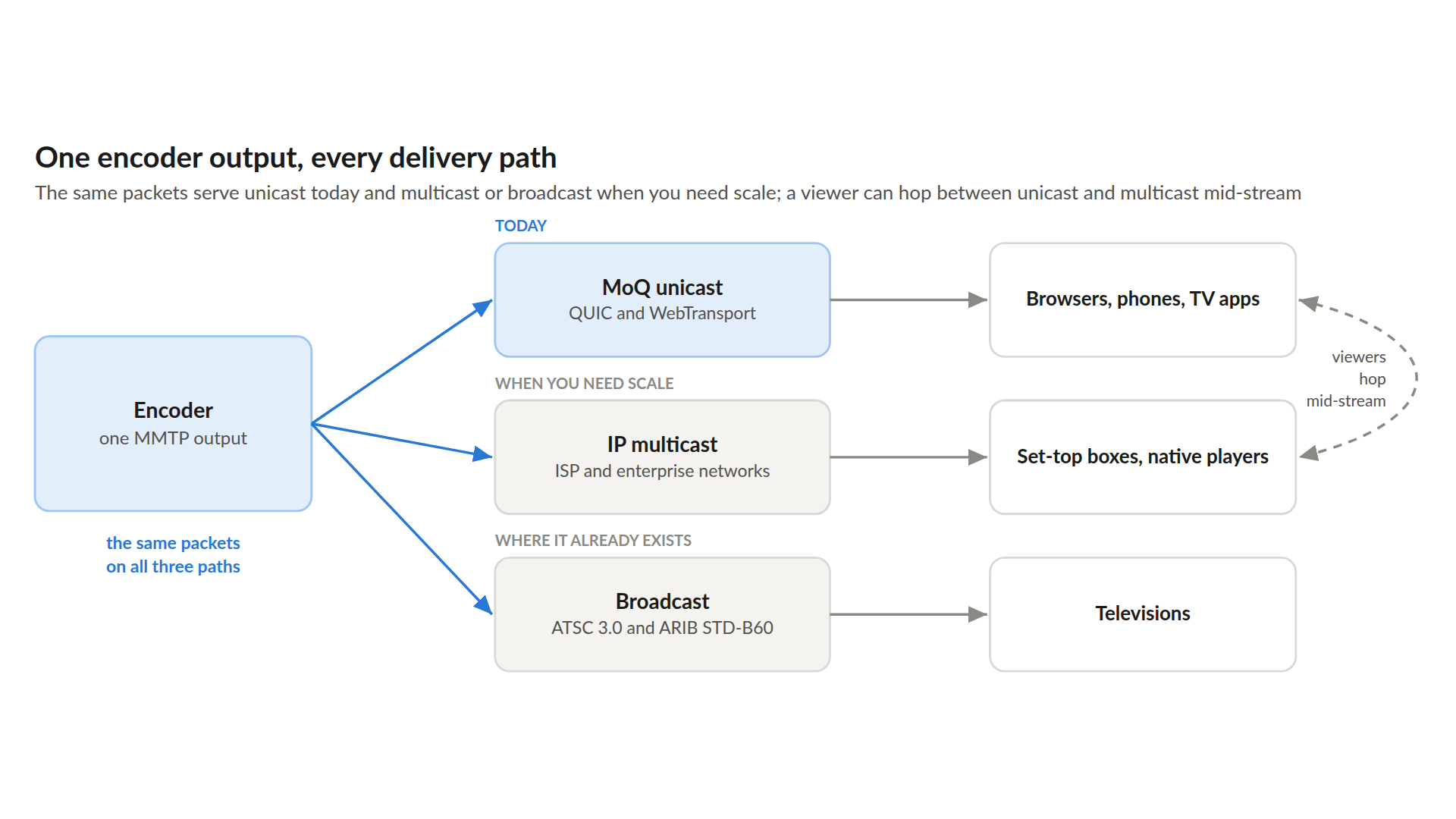
Each MMTP packet contains a fragment of standard media and fits in one datagram. On MoQ, each packet becomes one object. Relays forward it without needing to understand the MMTP format.
The same media packets can travel over multicast or broadcast unchanged. Where native multicast stops, AMT can tunnel those packets across a unicast network.
Receivers can use QUIC retransmission on two-way paths, rebuild missing packets with MMT repair data, or fetch extra repair through MoQ when the path supports it.
Inside the innovation
See how MMTP travels across the three paths and how targeted repair performed in Blockcast’s lab.
03 / How it works
The encoder produces a single MMTP output. Each packet fits in a network datagram and travels as one MoQ object.
A MoQ relay can serve a new viewer from its cached keyframe group without requesting media from the encoder.
Multicast and broadcast carry one copy along shared paths. Automatic Multicast Tunneling (AMT) carries those packets across unicast-only stretches.
Unicast and multicast carry the same media packets, so a viewer can switch delivery paths without restarting the stream.
Forward error correction (FEC) lets a receiver rebuild missing packets from repair data, even on one-way networks.
An optional repair track protects keyframes and their timing packets. In Blockcast’s multicast lab tests, it cut frozen-picture time from network loss by 97% at keyframes base repair missed, across three loss patterns.
04 / Where it plays
The Blockcast demo plays the live ISS feed in a Chromium-based browser using WebTransport. Native apps can use MoQ directly over QUIC.
ISPs and enterprises can distribute one copy over a shared network. Compatible receivers can switch between multicast and unicast without starting over.
Broadcasters already use MMTP in ATSC 3.0 and ARIB workflows. Blockcast’s drafts describe relaying a broadcast channel into MoQ without transcoding.
05 / See for yourself
Watch the live ISS feed over MMTP and MoQ, compare the available delivery paths, and inspect playback metrics in the browser.
Try the live demoQUIC playback runs in the browser. AMT and native multicast require a verified local Blockcast bridge; the demo guides you through availability and setup.
06 / Standards and IETF drafts
MMTP is the packet layer of MPEG Media Transport (ISO/IEC 23008-1). Blockcast’s IETF Internet-Drafts describe how to package and deliver MMTP in MoQ and how receivers can recover from loss across different networks.
These drafts are works in progress. If you build encoders, players, or distribution systems, review them against your workflow and share where they need to improve.
07 / Start A Conversation
Blockcast co-founder and CEO Omar Ramadan is based in San Francisco and will be at IETF 127 to talk with broadcasters, streaming teams, and encoder and player developers about MMTP, MoQ, and the drafts.
Meet Omar to discuss how one encoder output could serve your delivery workflow.
Book time with Omar Explore IETF 127